Arielle the Blue and Gold Macaw: Remarkable Speech Ability, Personality, and Care Requirements
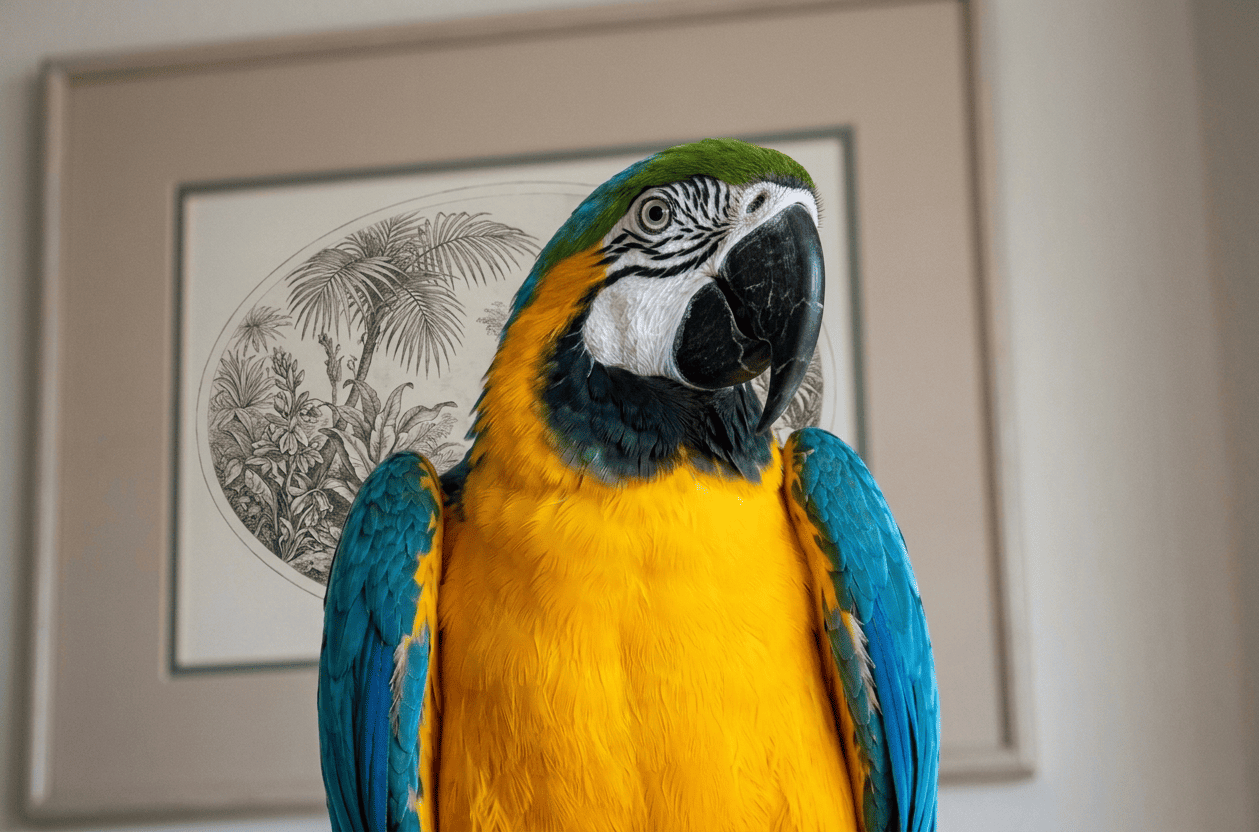
It would be unfair to avoid the subject of speaking abilities of macaws and other parrots. Macaws can reproduce the sound of human speech quite well or with various types of distortion. The matter becomes difficult because some sources state that macaws are not very good talkers, while others claim that macaws are excellent speakers.
There is insufficient space here to explain why. In a nutshell: Arielle achieves a level of speech that is unparalleled. Her words in the speech clip below reveal that she can do something unusual.
Arielle often assembles series of untutored statements. In this example she makes a pronoun substitution that shows a small portion of her understanding of English. Click the play button to hear her speak.
Arielle hopes that you find her story informative and interesting. She is a parrot-like bird whose relatives originally lived in tropical environments including the savannahs and rain forests of South America. Arielle is a member of the species Ara ararauna commonly known as the Blue and Gold macaw.
Brightly colored macaws are the largest parrot-like birds in the New World; their usual imposing size is between 33 to 36 inches from the crown of their head to the tip of their tail. If you imagine a macaw without its 20-24 inch tail feathers, the parrot would be about the size of a two-pound chicken.
Hobbyists and pet owners keep more Blue and Gold macaws than any other type of macaw, so a Blue and Gold macaw, like Arielle, is not considered a rare bird. What makes macaws popular parrots?
People are attracted to macaws by their sleek beauty and brilliant colors. Beyond their physical beauty, the birds have common endearing traits and develop individual personalities. Some macaws are very active birds, and they love to play with toys and disassemble things.
A macaw's antics keep the bird amused and can entertain its owners; however, care needs to be taken because large parrots can inadvertently ruin things in and around a home. Owners need to provide the birds with wooden-chew toys and people need to be vigilant about the bird's activities.
As an example, a playful macaw, when unsupervised, can destroy household objects. Arielle has at times chewed on wood molding around a doorway near her cage. When she is free in the house, she can walk up a spiral staircase and mount a wooden rail along the edge of our loft. She damaged the railing by breaking small chunks from the wood. This behavior is not done in spite; the bird is doing what comes naturally: wood is for chewing, and girls just like to have fun!
Macaws, like other parrots, benefit from what many people consider to be an inordinate amount of time with their owners. This is no coincidence. In the wild many parrot species pair off as monogamous couples and spend a lifetime together.
People ask me how much time one needs to properly care for a bird like Arielle. My answer is 4 hours a day extending over 365 days a year.
So, for a number of reasons, four hours is not an overly generous accounting for the time it takes to look after one's bird. It's like having a second wife, but each of us knows that before we buy a bird. The trouble is that most birds are short changed and it's not right. Don't buy a large bird unless you can forever devote four hours of each day to your feathered friend.
The significance of her statement exceeds the simplicity of the words she speaks. Arielle is substituting pronouns in her speech, so in this case she has created a new variation of what she was told. Her owner said to her, "You're a pretty girl," and/or "Arielle is a pretty girl". Here she voluntarily inserts the word "I" as the subject to refer to herself.
Beyond the pronoun substitution, she correctly conjugates the verb to match the subject, "I
Additionally, Arielle doubled up on the adjective "pretty;" that is because she does not have the word "extraordinarily" in her lexicon. She resorts to what small children do; she repeats the adjective to give additional weight to what she says. In effect, we learn that she is beyond merely pretty; she is "particularly" pretty.
Tweets
I don't know whether I told you or you could have read it in my book about a Peach-face Lovebird. Our adventure with talking birds started with a PFL that we had from a caapture at my wife's school.
Before we had our African grey parrot, Louie, we had the lovebird. I was ignorant and didn't know better, so I started to teach 'Tweets' to speak. I was not aware that birds could understand words and learn grammar, so I taught her using the old repetiton method. She was a smart cookie and soon started to speak. I had not learned to speak in a falsetto voice, so her speech was distorted because she attempted to duplicate my normal voice. Nevertheless, she developed quite a vocabulary, or at least words and phases that she repeated.
... "And now for the rest of the story." I went to the flea market in Oldsmar one Sunday to see about bird supplies, toys, and maybe another bird. I was wandering about when I saw a stand with different types of lovebirds. I paused to ask the fellow whether his birds spoke. He said, "Lovebirds do not speak!" He indicated something to the effect that he had lovebirds for more than 20 years and none of the birds spoke. Thus ensued a debate of sorts about whether lovebirds 'talked.' He was more adamant than I was insisting that lovebirds "do not speak." Of course, I knew better because Tweets definitely spoke English words, some more clearly than others. Even my relatives who visited were amazed by the speech by the little bird.
Not to be a know-it-all, but my challenger might not have known that many non-parrot birds can replicate speech. There are historical records of crows being taught to say "Hail Caesar!" Many contemporaties know about speech by crows, including one of the writers at a group who grew up with a pet crow. Most of the corvids can be trained to speak, or perhaps to understand words. Starlings can speak too, and I had an owner who sent me recordings to hear and decode. (Their speech required a learning curve because the pitch was higher than that of my parrots.)
"And now you know the rest of the story."
The story also shows that one should be receptive to new information, because one may be an 'expert,' "yet that does not mean that one knows everything ..."