Reasons for recording a talking bird
& suggestions for how to do it
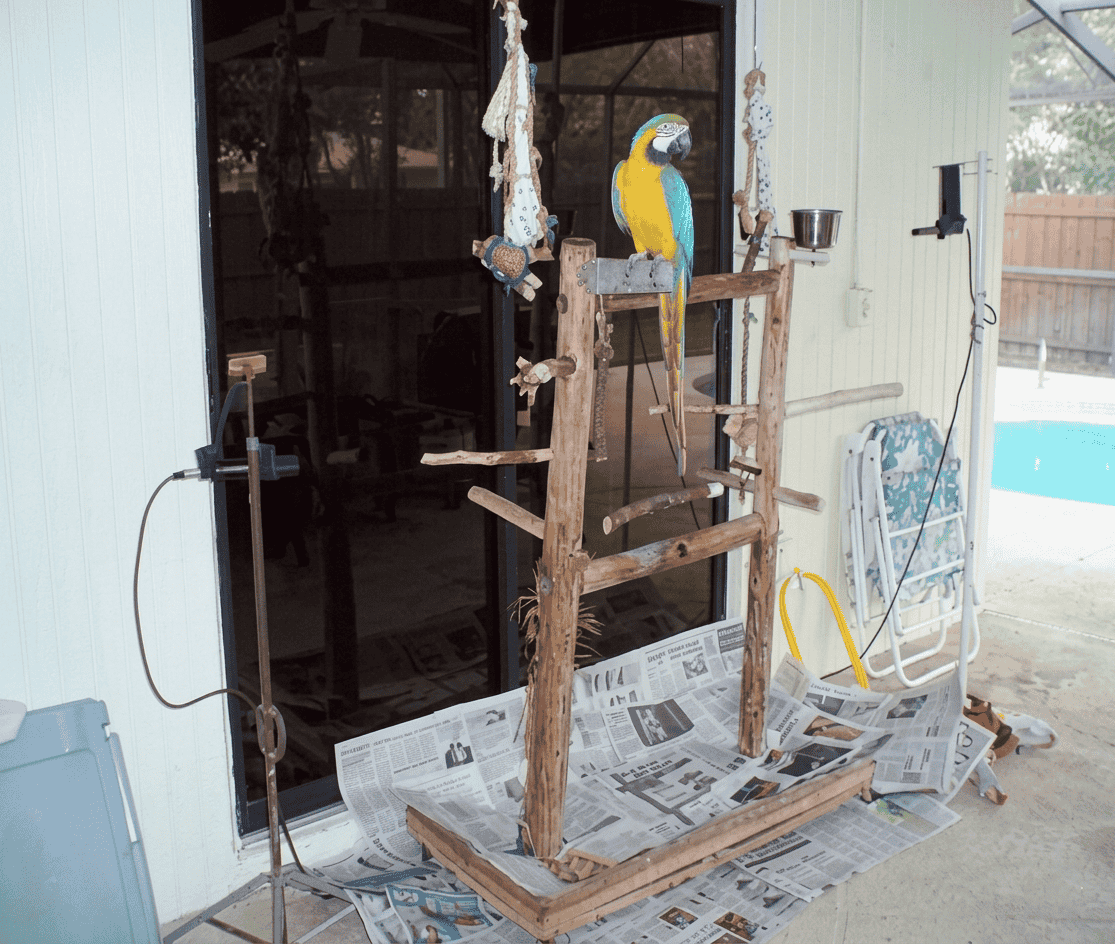 Photo by the author
 Arielle perches on a cement perch at one end of her gym. In this picture there are two microphones in position to capture her speech. The scheme permits recording Arielle's talking sessions from inside the house.
I improvised the microphone supports from a tripod salvaged from a junked projection screen; the other stand is a plastic water pipe on a Christmas tree base.
Reasons to record a bird's speech
- To permit friends to hear one's bird speak, as many birds do not speak when strangers are present.
- To prove the identity of your bird through its speech.
- As a history for study and familiarization by a new caretaker.
- To listen to a bird's speech in order to gain proficiency at understanding the bird's dialect.
- To permit others to study and analyze a bird's utterances, especially in investigations of meaning.
- By listening to a bird's words, phrases, and sentences, one learns whether his parrot is a participant in interspecies communication by conveying messages through speech.
Arielle says what most Americans say, click the play button to hear her words.
No transcription provided, as everyone will recognize what Arielle said.
The basics of recording bird speech
How to make your own bird-speech recordings
Recording bird speech can be done with comparatively primitive machinery, and that is precisely how I began which is a device that can be carried to wherever the bird is. Either the diminutive machine or a separate microphone can be placed close to the bird's cage or the perch from which the bird speaks. The disadvantage of a self-contained recorder is that it can pick up handling noise or noise transmitted through the furniture upon which the unit rests. Surrounding noise can mask the desired speech, especially if the bird speaks softly. An excited parrot can overload the recorder unless care is taken to position the machine a distance from a loud bird. Using the automatic recording level helps avoid distortion too.
A separate directional microphone will yield better results. A general-purpose cardioid microphone (one with a heart-shaped sensing pattern) will reduce undesired sounds from positions behind or to the side of the microphone. The user should experiment with the microphone position to obtain best results. A home "hi-fi" component recorder is likely an alternative to a portable machine.
Avoid a common error: recording at too high a level. Recording at excessive levels will cause the sound to be distorted. Using an audio cassette recorder is better than making no recordings, but the analog technology suffers from different problems, especially for long-term storage. Contact the author if you have questions.
Some years ago, I switched to recording Arielle's speech onto compact discs. The CD format does not suffer from the same defects as taped recordings and potentially offer a more permanent, archival, storage for data. People wishing to make recordings on other digital recording devices are encouraged to use whatever devices they find convenient.
Recordists using digital devices should be aware that sound files, depending upon the resolution selected, can consume a great amount of memory, and, as a result, are likely to require better management than I find time to do. Digital systems often distort severely, so attention to the recording level is exceptionally important. When first starting, I advise hobbyists to steer clear of expensive devices which might prove extravagant if you lose interest in the project.
Whatever equipment you choose, the important thing is to make some recordings!
My purpose for recording
My bird-speech recording started to show people that Arielle could speak a variety of expressions. After a while I came to recognize, not only was I hooked, but also that I had a full-time research project on my hands.
Arielle generally speaks softly, so hearing her voice can be difficult. Because I had been listening to her through glass doors (visible in the picture above) for years, in the past many words were either inaudible or not understandable due to the intervening glass.
Confusion can result when listening to a series of extemporaneous phrases. If the listener does not initially perceive the words, there is a chance that he will completely fail to comprehend the message. When one is writing the words on paper, it is difficult to listen to rapid speech and write a transcription simultaneously. Often by the time I figured out and noted a specific syllable, I had forgotten what she had said previously.
It is safe to say that I might have understood many unrecognized phrases if I had been able to refer to a recording. Complicating listening is the fact that Arielle talks, sometimes continuously, for 12-20 minutes. She does not repeat unique messages for a covert observer who might be listening to her words inside.
I began tape recording Arielle's vocalizing sessions fourteen years ago. Now, I record her daily as she speaks while perched upon her play gym. The amplified microphone placed outside close to her (shown above) much improved my ability to hear her vocalizations. Using headphones for monitoring makes it easier to concentrate upon her words, as the earphones minimize household distractions. The sound is considerably clearer after removing the effect of the attenuating glass barrier. This system is one that I should have installed years ago.
Arielle's speech is sometimes difficult to understand. Current technology makes it easy to review her sometimes rapid pronouncements at a slower pace. If her speech is slurred, on replaying her statements, likely target terms can be determined from the context of her speech.
During the first two months of recording, she generated two-and-a-half hours of articulations to analyze. Arielle spoke 426 permutations of phrases and words as established by counting the occurrences on the transcription for the recordings. Numerous common parlances were repeated. Her current rate of production, which is variable, has increased to 80 minutes of speech recorded over a period as short as two days.
Before recording her speech, there was no second opportunity to comprehend Arielle's expressions. Compared with simply listening through the door, I now hear many more of her expressions. It is difficult to write as fast as Arielle can speak; if she starts speaking at a high rate, it is certain that one will miss parts of her monologue. By playing back the program, it is possible to fill in the words missed during simultaneous transcription and real- time listening.
Over the last years, the macaw's speech production has increased markedly; either that, or, perhaps, I am simply more aware of her vocal sessions. I suspect that Arielle's vocabulary will continue to grow, because she seems to be warming up to perform something more spectacular and more astounding than what she has already done. Arielle is a bashful individual; however, she generally speaks covertly when she is outside on her perch with no people present. I am in an awkward position, since I have been unable to determine what her clandestine plan is, but, in time, she will communicate it to me.
Recording speech sounds ultimately leads to comparing the words using a computer as a tool for analyzing the sounds.
To see the sound spectrum contained in my speech and Arielle's speech click on the word to the right: Spectrogram