Words and Sound:
Difficulties with Speech as a Means
for Interspecies Communication
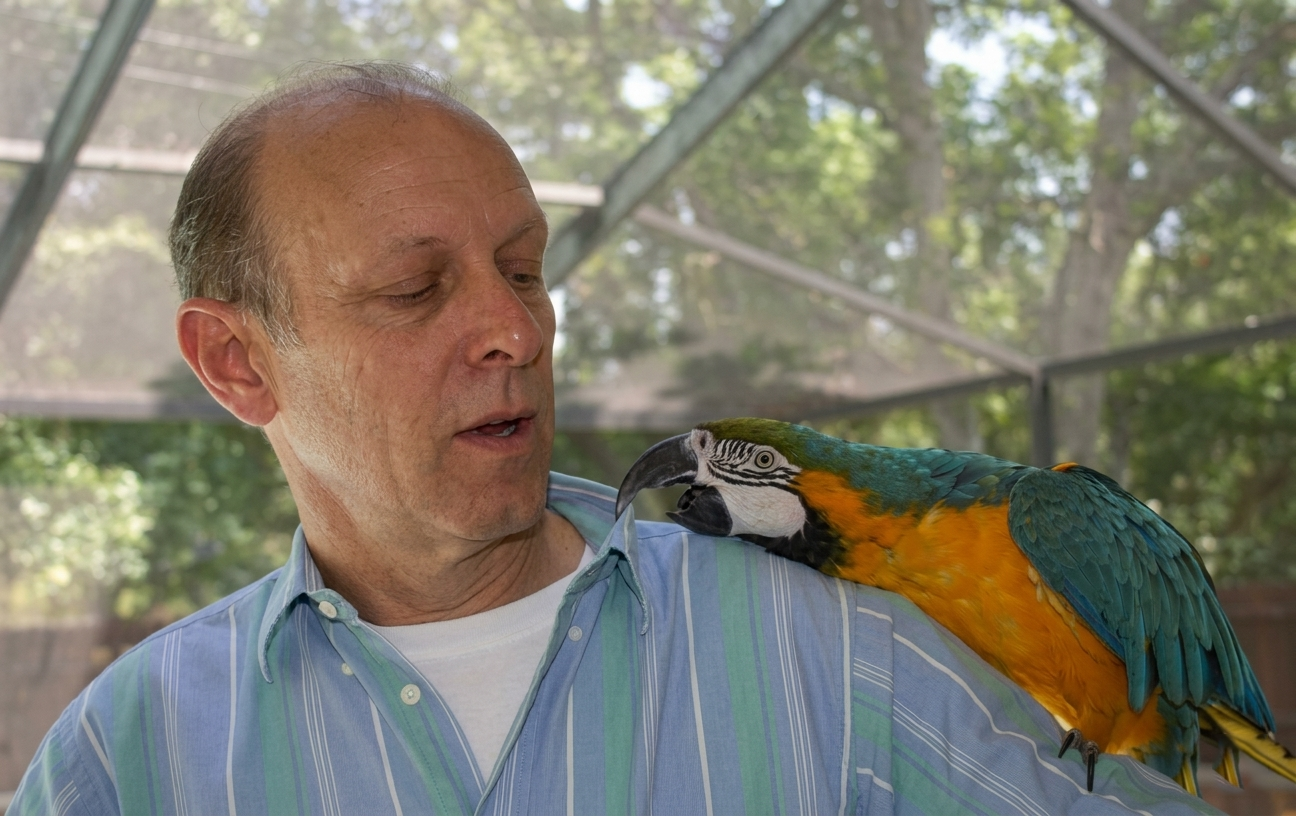 Photo by Linda Carpenter
 Some possible difficulties in discerning a bird's speech:
- rapidity of the bird's speech, as parrots often learn to speak quickly
- tone of the bird's voice, a human voice sounds considerably different
- intonation used in speaking, a bird may put unusual stress on syllables
- the cadence of speech, the pattern could reflect an owner's speech
- "clipped" syllables, are some words incompletely said?
- isolated or contextual speech?
- slurred words? (either indistinct or linked to other words)
- unusual words in the bird's vocabulary
- the listener's inexperience with the dialect of a bird
- lack of common vocabulary between listener and the talking bird?
- insufficient effort on the part of the listener to comprehend the bird's words
- hearing loss, an age-related hearing deficit, in older adults challenges them
- lack of eye contact or visual clues on sound recordings
Challenge your listening skills with a sample of Arielle's spontaneous speech.
(Sound slowed to help you.)
Interspecies Communication with Talking Birds
There are several problems in receiving messages from a talking bird. Part of the problem is reflected by a statement about "inattentional deafness" by Temple Grandin in Animals in Translation.
A listener must be interested enough to determine the message transmitted by a speaking bird. Since many bird owners neither actively listen to their birds nor pay much attention to the bird's speech, who then will receive the bird's message?
Many people enjoy hearing a parrot repeat stock phrases. However, the novelty wears off soon and then the difficulty becomes apparent; people assume that a bird's early speech is not meaningful, but they are often wrong. An owner needs to recognize and explore the bird's ability to use language during "a window of opportunity," usually during the bird's early dealings with its owner. Future communicative opportunities might be lost, because a bird simply gives up when it receives no response. Out of boredom, parrots revert to repeating mundane phrases that cause a reaction.
If you listen to your bird and work with your bird, there is a much higher chance that you will be able to communicate at least on occasion. For example, Arielle learned to ask, "Hurt?" The word is posed with a rising pitch to indicate the questioning nature of the utterance. The full translation for her abbreviated question is: "Is that something that is likely to hurt me?" (Linguists call such words holophrases; in such utterances, a single word expresses a basic sentence.)
My surprising finding is that people generally do not comprehend Arielle's speech, at least not the isolated taped speech of my macaw. Why is that?
A child's parents usually understand their offspring's irregular speech, but a befuddled stranger often finds the child's speech incomprehensible. A parrot is considerably smaller than an adult human and has vocal characteristics similar to that of a toddler. The bird's voice emanates from its syrinx, which generates sound in a considerably different way from a human vocal tract. I believe these factors combined with those presented in the list above explain why people find understanding recordings of bird speech difficult. I work at analyzing Arielle's unclear speech.
What is surprising is the lack of interest in bird speech among parrot owners. Many enthusiasts buy a talking bird specifically for its ability to speak. Yet the typical owner, as well as the general public, is not tremendously interested in what a bird says or whether it communicates. People don't try hard enough to comprehend bird speech, and, as a result, they miss the exhilarating experience of hearing cognitive speech by their bird.
One has to work to develop an appreciation for the messages transmitted by birds. Learning to transcribe a parrot's speech has been likened to learning a foreign language. People generally accommodate strangers attempting to speak English with a foreign accent. Yet, listeners are reluctant to grant the same courtesy to a talking bird that speaks with an accent. The least we can do is work to determine words spoken by a bird, because a parrot exerts an enormous effort to learn human language and to communicate in an unfamiliar way. The study of words spoken by a parrot is worthwhile. Parrots like Arielle try to communicate a range of information to their owners. One story about a communication by Arielle is reproduced on the MacawSpeech page of this site.
Owners who listen intently will find that their talking birds are trying to communicate. Bird keepers can learn how to listen to parrot speech in order to decode the message. This is sometimes a daunting task, but one that will be greatly rewarded for the effort.
We don't have to look to outer space for intelligent life with which to communicate. An intelligent, and sometimes very opinionated, creature could be as near as the parrot on one's shoulder.
Need Help Decoding Your Bird's Speech?
Are there portions of your bird's speech that you do not understand? I will try to assist in determining a short passage from your bird's speech. The following media are suggested: an audio compact cassette, a CD, or an attachment to an e-mail (sounds.wav file).
You may be as surprised by what your bird is saying. I was.
Arielle spoke in a higher-than-normal-frequency voice. In her first utterance, she says a rapidly spoken and shortened version of "(Do you) Feel better?" After a brief pause, she ends in a higher-pitch voice saying, "Put your foot there!"
(From a February 2006 impromptu session.)
ℹ️ Notice !!!
As of February 2026, there is a new group at Google that deals with speech by talking birds and other topics of interest for bird enthusiasts, linguists, biologists, animal trainers, or anyone who wishes to explore concepts relating to communicating with a talking bird. The description appears below.
People interested in the study of spontaneous speech by talking birds. The topics of concern include learning about parrot-like birds, speech perception, linguistics, cognition, consciousness, and other topics related to the talking birds. To join click on the image below or submit your request to the group by entering the subscription link into your browser.
Subscribe email: parrotspeech@yahoo.com