The home of the pioneering talking macaw called Arielle
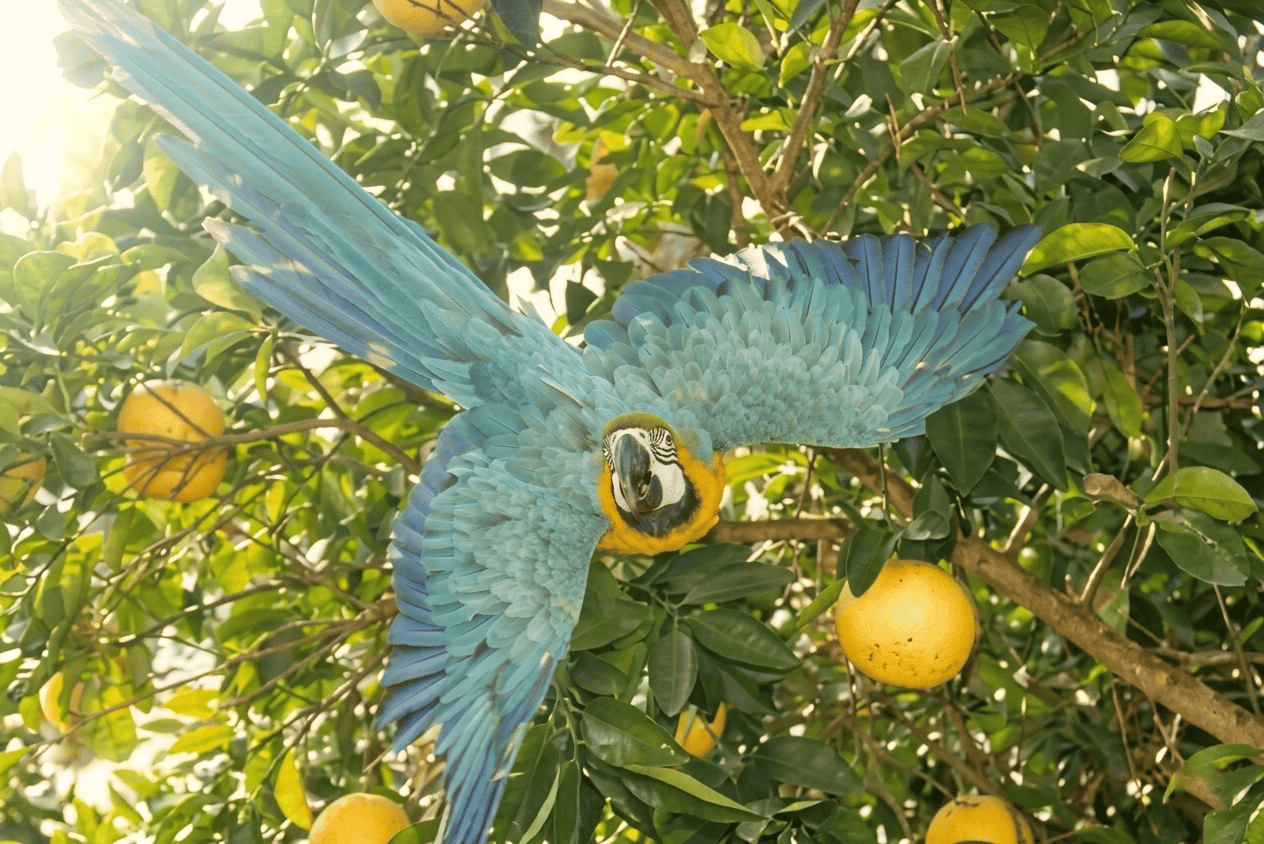
Originally, I hadn't intended to perform speech research with a parrot. Arielle was the motivating force behind my interest in interspecies communication with a talking bird. It was Arielle's early ability to comprehend English words that started my quest to understand how she learned to use words correctly in new situations; she exhibited her ability to apply words correctly, even though she had received no instruction for the particular expression.
The articles on this page are edited from my manuscript for a yet-to-be- published book about our first six years together, tentatively titled Arielle: A Macaw's Diary. This is one of two manuscripts I have written dealing with free speech by a talking bird.
I have been involved with Arielle, other talking birds, and parrot speech investigations for more than 30 years. During the time, I've learned a great amount from her about the ability of talking birds to understand and to use human language correctly. For more information about the book, Another Kind of Mind: A Talking Bird Masters English, click on the link.
To listen to Arielle speak, click play. If, after hearing her speech, you can't determine what Arielle said, the transcription is in a yellow box below.
Notice that she speaks with two different voices. Do you know why?
Rescue from a Tree
Arielle and I were visiting a local park; we had walked three-quarters of the footpath encircling the lake. A large bird spooked Arielle, and she jumped from my shoulder and flew into the wind. Her flight took her away from me over a portion of the water and back toward some tall trees.
She had landed on a tree branch more than 30 feet above ground. I called home from a house adjacent to the park and asked my wife, Pat, to bring my rescue kit to retrieve Arielle from the tree. The pole extended to 20 feet and, with a T-perch attached the total length was about two feet longer.
Training a bird does pay off. With my heart racing and the sound of my pulse in my ears, I commanded Arielle to step upon the T-perch. "UP!" I shouted in the calmest sounding, most businesslike voice I could muster. Arielle raised her leg; she was going to step onto the perch.
P.S.
I recommend that beginning parrot owners use a tether if they want to take their birds outside.
Only a disciplined parrot owner, who has practiced walking with and rescuing his bird outdoors, should
attempt to handle an unrestrained parrot outside.
Goblin
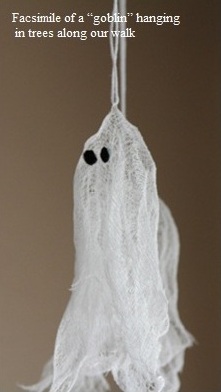 Halloween goblin decoration
 During our customary walk this evening, Arielle said a distorted two-syllable word, one that I did not immediately comprehend. As we walked, I made a mental note of the Halloween decorations, hanging in the nearby trees, swaying in the wind. After thought, the word that fit her utterance came to mind: "goblin."
How had she learned to relate the ornamentation to that word? Arielle had previously seen Halloween trolls, ghosts, goblins, and scarecrows around the neighborhood. When "Trick or Treaters" arrive at our home, I allow the birds to observe the colorful costumes worn by little "kids."
To allay her fear, I told her, "Okay … No hurt!" and that the ghostly visitors were "goblins." I described outdoor decorations hanging eerily from trees using the label goblin as well, so that is how Arielle learned to say goblin.
NPR Feature
Arielle was the subject of a discussion recorded by Story Corps, part of the National Sound Archives when they visited the Tampa Bay Area. A portion of the interview about instructing Arielle to learn the English language was aired on NPR during the program "All Things Considered."
Arielle spoke in two voices. In the first part of her utterance, she employed a low-frequency voice saying, "You're rotten." After a brief pause, she adds, "I know," which is spoken in a humorous sounding voice. A peculiar tone in her voice gives away what would have been a smirk on her face, if she were a human being, while making the teasing comment.